Frequently asked questions:
-
We honour ‘hauora’ as a core principle. Which acknowledges spiritual, mental and physical development of the child as equally important. The goal of our program is to aid the child in reaching their full potential in all areas of life. Our activities or mahi support the development of social skills, emotional maturity, physical coordination and cognitive readiness. Tamariki (children) are guided by Montessori trained kaiako (educators.) The holistic curriculum enables children to develop a love of learning, go at their own pace to fully engage in the process, build self-confidence, and gain meaningful experiences through which they construct their knowledge.
-
Dr. Maria Montessori, after whom the philosophy was named, believed that children learn best within a social environment that supports each child’s individual and unique development. What are the foundational beliefs of Montessori education?
Children are to be respected as different from adults and as unique individuals each with their own gifts and talents.
Children create themselves through purposeful activities.
Birth to three years of age are the most important and impactful time for learning.
Children under the age of six have an ‘Absorbent Mind’, or unusual sensitivity and mental powers for absorbing and learning from their environment (people and materials.)
-
Each of our five class environments operates on the principle of freedom within limits. We follow the rule of RESPECT; for self, others and things/environment. The ground rules differ at different age, stage and ability but all follow Montessori’s core beliefs, Respect, and Tikanga. Children are free to work with their chosen activity for as long or as short as they like. Observations by kaiako are key in Montessori practice to discern which activities or new materials will be presented to the child or small group. Striving to encourage self directed learning and activity and balancing individual mastery and small group collaboration within the whole group as a community.
-
In Montessori environments the three year age span nutures a whānau like learning community where tuakana-teina relationships flourish naturally. Older tamariki consolidate their own understanding as they support younger peers; while younger tamariki are inspired by observing and working alongside those with more experience. This rich social exchange strengthens oral language, collaboration, and a strong sense of belonging.
Maria Montessori recognised that tamariki learn best within a mixed age setting where development unfolds at an individual pace. Rather than expecting the child to fit into the programme, our Montessori environments are thoughtfully prepared to respond to each child’s stages of growth, interests and readiness.
-
In Montessori Children’s Houses’ there is typically one head teacher supported by a class teacher and 25-35 children. This structure along with the mixed age group and prepared environment, supports a vibrant and purposeful class community where learning energy flows from the children’s engagement with a wide range of meaningful activities. Each of our four classrooms have three dedicated kaiako- (putting us in a ratio of 7-10 children to 1 teacher.)
Within this setting, independence and interdependence are fostered simultaneously. Children encounter diverse social situations, collaborate across ages, and develop empathy and leadership. The tuakana-teina dynamic- where older children guide younger ones, is a hallmark of the Montessori approach and strengthens both confidence and competence.
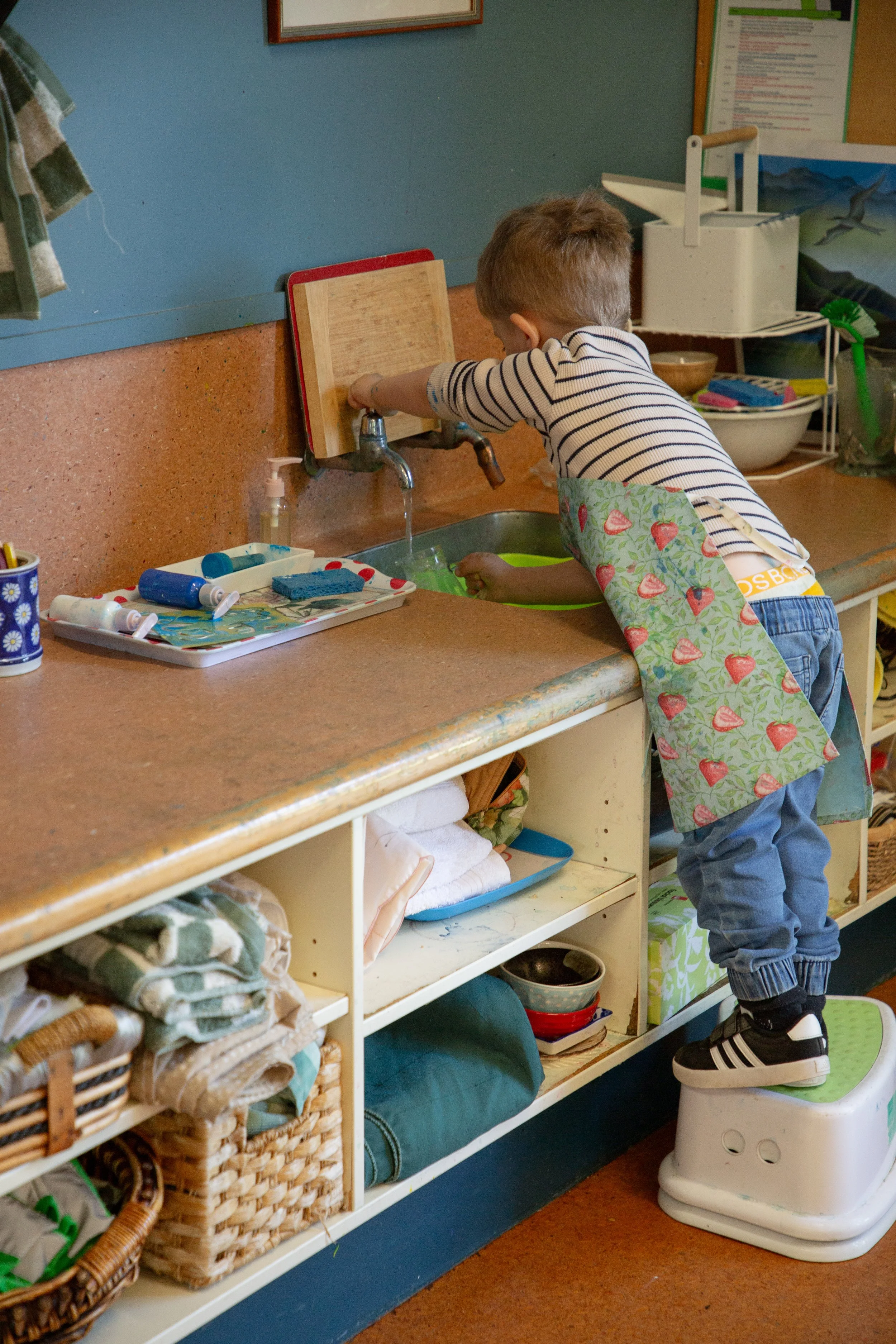
The carefully ‘prepared environment’ enables tamariki to manage their own learning with minimal adult intervention. This intentional design builds self-belief, responsibility, and agency- key strands of Te Whāriki- while offering intellectual, personal and social opportunities that extend beyond those of a traditional classroom.
-
Our classrooms offer a balance of freedom within clear and consistent boundaries. Across the three year age span, children access a wide range of carefully, sequenced and scientifically designed activities that support individualised learning, steady progress, and growing independence.
Children are free to choose purposeful work that aligns with their interest and developmental readiness. Each material has a clear purpose and is presented by the kaiako. Through repetition and exploration, children deepen concentration and mastery.
The teacher observes attentively and guides gently when needed, ensuring that the child’s choices remain constructive and meaningful. Central to Montessori philosophy is respect for the child unique developmental journey- supporting them to grow to their full potential rather than teaching solely to age-level expectations.
-
The Montessori teacher acts as a guide and careful observer. Through close observation, the teacher comes to understand each child’s strengths, needs and emerging interests. This insight informs preparation of the environment and the introduction of materials that will support further growth.
Teaching is intentional yet indirect. The kaiako follows the child, remaining responsive to the pathways to which the child is drawn. By offering timely guidance and encouragement, the guide supports the child in settling and acknowledging meaningful goals, fostering autonomy and intrinsic motivation.
-
Children educated within a Montessori environment often demonstrate self-discipline, independence, and a genuine enthusiasm for learning. They develop confidence in making choices, sustaining concentration, completing tasks and caring for their environment.
Observers frequently note the calm, purposeful atmosphere of the classroom. Children move with intention, show respect for materials and one another, and take responsibility for their learning.
The qualities cultivated; resilience, problem-solving skills, self-esteem, and a love of learning well beyond the early years. These enduring dispositions support lifelong learning and well-being across all stages of education and adulthood.
-
From birth to six years, children experience an extraordinary period of growth during which character, identity, and intelligence are being formed. Montessori described this stage as the time of the ‘absorbent mind’, when children unconsciously and effortlessly take in impressions from their environment.
These impressions do not simply add to the child’s knowledge- they shape who the child becomes. The early years lay the foundation for self-constructions, creativity, and the capacity to think and understand. A rich responsive environment , such as our Montessori prepared environment, during this period is therefore essential in supporting holistic development, as reflected in the strands of Te Whāriki.
-
Our Montessori programme is designed as a cohesive, consistent learning journey rather than a series of isolated lessons. A five day week provides rhythm, predictability, and continuity - elements that meet the young child’s need of a ‘sense of order’, security and belonging.
Regular attendance allows tamariki to sustain friendships, contribute meaningfully to their community and fully engage in long cycles of uninterrupted work. Repetition over consecutive days deepens mastery and strengthens neural pathways.
Given the breadth of experiences available in our Montessori prepared environment, consistent preparation maximises each child’s opportunity to explore, practice and expand their learning. This is why a five day programme best supports the child’s holistic development and natural learning process.
helping our tamariki and whānau flourish